A blazer should give you the shape you want while allowing the movements you need, over the clothes you intend to wear beneath it. Check the shoulders, front, sleeves and back together. A neat sleeve length does not compensate for a chest that pulls, and a relaxed silhouette does not have to mean an uncomfortable fit.
Before you keep a new blazer, try it with your usual base layer and do a few ordinary tasks. Look at the front, side and back, then compare what you see with what you feel. That gives you a more useful decision than choosing by the size label or a single mirror pose.
This guide is especially useful when a jacket’s proportions seem close but not quite right. The photographs are AI-generated illustrations showing different views and details. They are not a controlled fit test, and no image can establish how a real garment feels through a working day.
Decide what you want the blazer to do
Start with one real use: a jacket to wear over a thin top at work, a relaxed layer with jeans or a piece for an occasion where you want it fastened. Those choices change the comparison. You may want different room, sleeve coverage or jacket length for each one.
Write down the underlayer as well. If you expect to wear a long-sleeve shirt, try that shirt beneath the blazer rather than assessing everything over a sleeveless top. A lining and two sleeves can interact in ways that are not apparent when the jacket is tried on alone.
Separate the desired outline from movement. You might enjoy a roomy shoulder or a longer hem and still need comfortable upper arms. You might prefer a fitted waist without wanting the button under tension. Naming both goals makes it easier to compare jackets instead of treating every loose or close area as automatically wrong.
Your try-on brief: “I want to wear this blazer over ____, mainly for ____. I prefer the front open or fastened because ____. The task it needs to accommodate is ____.” Fill in those details before changing sizes. They help you judge the garment against your own use.
Read the front without holding a special pose
The navy blazer illustration gives a clear view of the lapels, fastened button area and lower front edges. Use it as a reference for where to look, not as a template every jacket must copy. A shorter, longer or deliberately roomy design can have a different intended outline.

Let your shoulders settle and stand as you normally do. Look at whether you like the neckline and the way the fronts hang over your base layer. Avoid pulling the jacket downward or drawing your shoulders back just to make the mirror view smoother. You want to assess an ordinary wearing position.
For a blazer designed to fasten, close the appropriate fastening without forcing it. Notice any strong pulling around the button, lapels lifting away or pressure you feel across the chest. Release it and compare. These observations help describe the problem; they do not identify a single guaranteed correction.
A blazer designed as an open-front layer needs a different check. Do its edges sit where you want them, and can you reach comfortably? There is no missing button to test. Judge the construction it actually has rather than rejecting it for failing a closure rule meant for another jacket.
If a buttoned style feels good only when open, decide whether that limitation fits your plans. You may be happy wearing it that way, but test movement and the view from behind as well. Leaving the front open does not establish that the upper back and sleeves have enough room.
Shoulders and upper arms belong in the same comparison
For a conventional set-in sleeve, the shoulder seam gives you a useful place to start looking. A deliberately dropped or extended shoulder has a different design. Compare the jacket with its intended cut instead of forcing every seam to land in the same place on every body.
Then let your arms hang and reach gently toward a table. Does the sleeve feel comfortable through the upper arm? Does the jacket pull across the back before your hands reach their ordinary working position? Observe both areas, since a pleasing shoulder line alone does not tell you what reaching will feel like.
When comparing sizes, repeat that movement rather than judging only which front looks smoother. The larger version may give you the room you wanted, or it may change the neckline and shoulder shape more than you like. Another cut can be a better comparison than another size of the same design.
Primark’s blazer-fit guidance also highlights room at the bust, sleeve movement and closure. Treat those as useful areas to inspect. Your preferred silhouette still matters; a retailer’s styling preference does not create one mandatory waist or hem position.
Check sleeves from the side, with the real underlayer
In this illustration, a gray blazer is open over a blue shirt, with a little shirt cuff visible at the wrists. The angle makes the sleeve ends easier to see. That relationship is an example, not an exact cuff measurement you need to reproduce.

Look at the sleeve with your arms relaxed first, then bring your hands into the position you use for typing or holding a bag. Decide whether the end stays clear of your hands and whether you like its coverage. Different sleeve designs, shirt cuffs and personal preferences can produce different answers.
If the jacket sleeve seems awkward, check that the shirt underneath has not folded or collected inside it. Smooth the two layers separately and try again. A sleeve that feels better after one adjustment is different from one you must keep tugging every time you bend an elbow.
Rolling a sleeve can be a styling choice, but try the arrangement long enough to see whether it stays as you want it. Do not assume a quick fold is a permanent solution to unwanted length. If you are considering shortening, ask a professional to assess the actual cuff and construction first.
Check the jacket with another underlayer only if that reflects a real outfit you would wear. If it works over a thin top but not your usual shirt, that is useful information about its role in your closet. You can choose a narrower use or continue looking for a jacket that serves both.
Take a back view before making the decision
The camel jacket illustration shows the collar area, shoulders, center back and lower hem from behind. These are easy to miss in a front-facing mirror check. Use another mirror or a photograph if available, while recognizing that camera angle can change the apparent proportions.
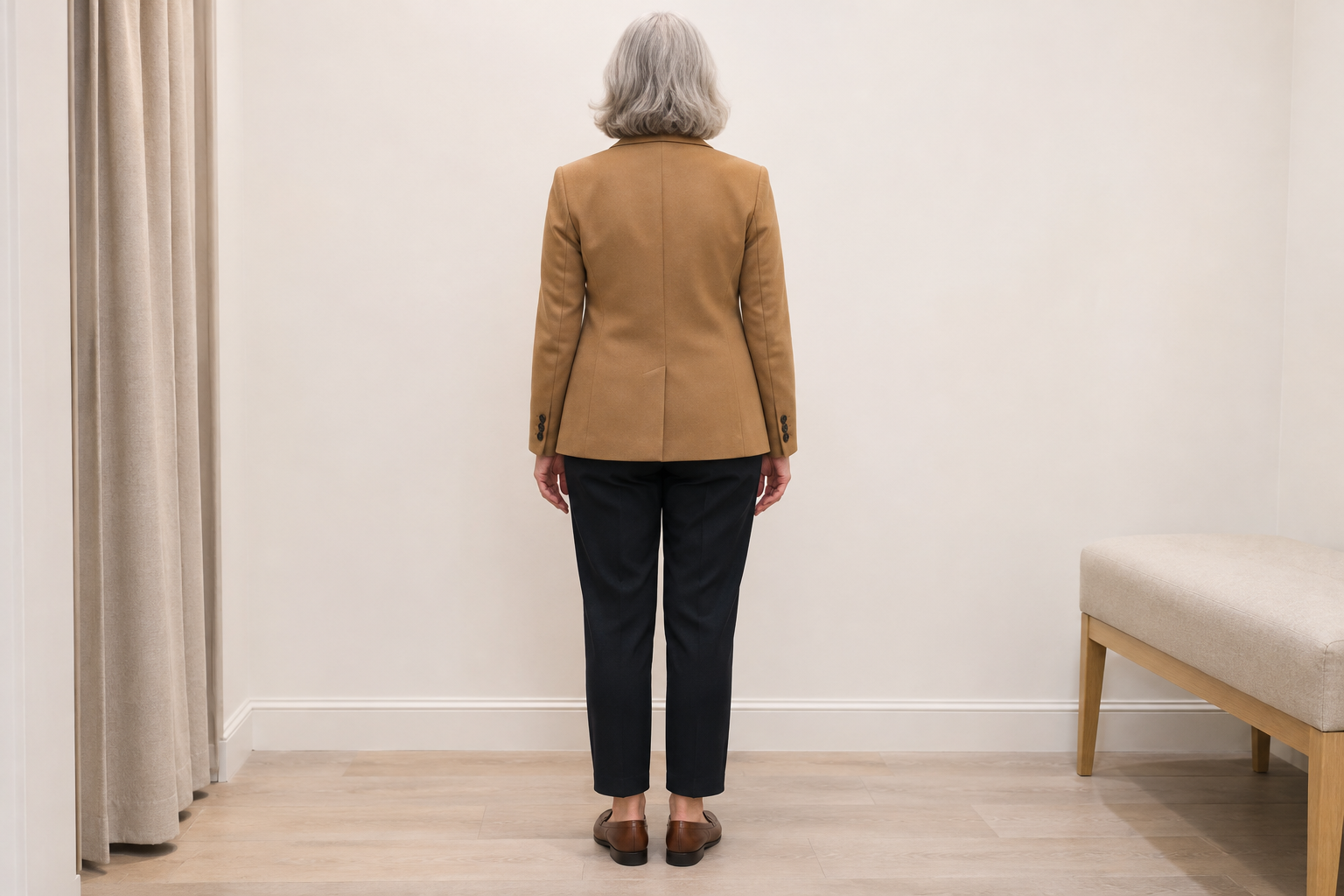
Keep your stance natural and observe whether anything catches or draws your attention. Then move and look again. A fold produced while reaching is not the same observation as fabric that remains caught after you relax. Describe what persists rather than trying to remove every crease from a real garment.
Pay attention to the back collar and the area across your shoulders. If they sit differently when you change underlayers, repeat the comparison with the one you intend to use. Avoid deciding that one visible gap always means the same technical problem; several aspects of the garment and posture can affect the result.
If the jacket has a back vent, inspect its construction and any temporary stitching before treating its appearance as a fit verdict. Check the retailer’s instructions or ask for help if you are unsure what should remain in place. Do not cut unfamiliar stitches while you are still deciding whether to keep the jacket.
Length is a choice to compare with your outfits
A blazer does not need to end at one universal point because you are shorter. Put it over the pants, skirt or dress you actually intend to wear and look at the overlap. You may enjoy a short jacket above a fuller skirt or a longer line with straight pants.
Check function as well as the standing outline. Sit in your normal chair and notice whether the lower edge folds somewhere inconvenient. Place your hands in the pockets if you plan to use them. Their position can matter to your experience even when the jacket length looks appealing.
If everything works except the visual length, compare another jacket before assuming shortening is straightforward. Pocket placement, front shape and other construction details may affect what can be changed. An alteration assessment should address the actual garment and the result you want, rather than a general promise about blazer hems.
Choose the next comparison from the problem you noticed
Keep the description specific. “The right sleeve covers my palm” is more useful than “this is not petite enough.” “The front pulls when fastened over my work shirt” gives a clearer starting point than “the size is wrong.” You can then compare one relevant change and see whether it helps.
| What you notice | Useful comparison | What to recheck |
|---|---|---|
| Pressure across the chest when fastened | Another size or cut over the same top | Shoulders, neckline and upper arms as well as the button |
| Sleeves interfere with your hands | Another sleeve length or professional assessment | Cuff construction and movement over the intended shirt |
| Roomy front but restricted reaching | A different jacket cut | Upper back and sleeves during the same ordinary task |
| Comfortable fit but an unwanted hem position | Another length over the same outfit | Pockets, seated overlap and the desired silhouette |
Repeat the same simple task in each version. Changing the jacket, shirt and bottoms together can make it difficult to identify what helped. You do not need an elaborate fitting session; a consistent comparison with the garments you use most is often more informative than several unrelated outfits.
Ask about alterations before relying on them
An almost-right blazer may be worth discussing with a tailor, but the possible work depends on that garment. Explain the wearing problem and the outcome you want. Ask what can be changed, what the finish would look like and what the total cost would be before deciding to keep it for that purpose.
Do not assume that changing one area leaves everything else unaffected. Ask whether the proposed work would alter the look of nearby details or require additional changes. You can also ask to see how a proposed length or shape is being marked before authorizing work.
Compare that option with another size, a different cut or returning the jacket under the applicable conditions. A low price does not make an uncomfortable blazer useful, and a high price does not mean it deserves further spending. Choose the route that solves the problem you actually want solved.
Inspect the garment before it becomes part of your rotation
While you are still deciding, follow the retailer’s try-on and return conditions. Check the current deadline and requirements directly rather than assuming every store treats tags, wear or alterations the same way. Leave permanent changes until you have made a clear decision about the purchase.
Look over the lining, seams, fastenings and pockets on the actual item. If something seems damaged or unfinished, ask the seller before treating it as a normal feature. Keep a fit issue separate from a condition issue so the next conversation addresses the right problem.
Read the care label too. A jacket that suits your outfits may still require care you do not want to manage. The FTC’s care-label guidance explains the role of garment-specific directions. A textured or smooth appearance in a photograph does not establish fiber content or washability.
Make the keep-or-compare decision
Put the blazer back on with your intended top and one complete outfit. Stand, sit and reach normally, then remove it without changing the rest. For ideas about building that base, these everyday outfit combinations provide starting points you can adapt to clothes already in your closet.
Keep the jacket when its role is clear, you like its outline and the trial gives you no unresolved wearing problem. Compare another option when you are still explaining away pressure, restricted movement or continual adjustment. If professional work is part of the plan, resolve that assessment before relying on an imagined result.
Save a short note of what you learned: the jacket, underlayer, preferred front arrangement and any specific difficulty. That note will help with the next comparison. It gives you a practical reference for your own clothes, without turning one successful blazer into a rule for every future purchase.

Alia Hashim
I'm Alia Hashim — a passionate blogger and founder of Modern Lady Magazine. I started this platform to create a space where women could find inspiration, empowerment, and real-life solutions for style, beauty, wellness, and beyond. Through Modern Lady Magazine, I aim to celebrate the modern woman — confident, creative, and full of dreams — while sharing ideas that help nurture both inner strength and outer beauty. Every story, every tip, every idea here is crafted to inspire you to embrace your journey and live life beautifully, one step at a time.
View author profile →