
Before choosing a size, find out whether the chart describes your body or the finished garment. A body chart is compared with your body measurements. A garment chart is compared with measurements of clothing, using the retailer’s stated method. Confusing those two can produce a poor choice even when every number has been measured carefully.
The next questions are whether a number is a flat width or a full circumference, which units it uses and where the measurement starts. Once those are clear, you can compare room, length and intended shape separately. This guide explains body measurements versus garment measurements without assigning one correct amount of looseness to every reader or every fabric.
Identify what the size chart actually describes
Look above and below the chart for phrases such as body measurements, garment dimensions, finished measurements, laid flat or to fit. Open any measurement diagram linked beside it. The size letter alone does not reveal which system is in use, and a familiar-looking number is not enough evidence to choose one.
A product may show both a general body chart and item-specific garment dimensions. Keep those sources separate in your notes. The first helps identify the brand’s suggested starting size; the second can help you compare the actual shape with something you own. Neither should be silently substituted for the other.
| Chart description | Useful comparison | Common mistake |
|---|---|---|
| Body bust, waist or hip circumference | Your body at the stated point | Adding an extra allowance before consulting a chart intended for body measurements |
| Finished garment circumference | A comparable finished garment circumference or a clearly understood ease calculation | Treating it as the body size the garment must fit exactly |
| Flat garment chest width | A familiar garment laid flat using the same method | Subtracting a full body circumference from a half-width |
| Garment length or sleeve length | The same route and endpoints on a reference piece | Assuming every brand starts the tape in the same place |
For a real example of why the label matters, Lis Bonne Atelier’s measurement page describes its charts as flat garment measurements in centimeters and recommends a similar reference piece. That is the method for that retailer, not a rule you can apply to every clothing website.
Write a body record and a clothing record separately
Your body record should name each point and the units. Follow the chart’s own instructions, wear the underlayers relevant to the purchase and stand naturally rather than pulling yourself into a different posture. A measurement taken tightly over a bulky sweater is a different observation from one taken over a light underlayer.
Use a soft tape and keep a circumference measurement level, with help if you want it. If repeated readings differ, check the tape’s position before averaging them into a number that may describe neither attempt. Write down what you actually measured and leave uncertain entries marked as uncertain.
Your clothing record serves a different purpose. Choose a piece you currently like wearing for the same job: a woven blouse for a woven blouse, or a relaxed sweater for a similarly relaxed sweater. Record its construction, fabric behavior and whether you measured it closed, open, relaxed or stretched.
A reference does not have to be perfect everywhere. You might like its chest room but want shorter sleeves. Mark those distinctions so a new garment does not inherit every detail by accident. The best reference note explains both what you want to keep and what you are trying to change.
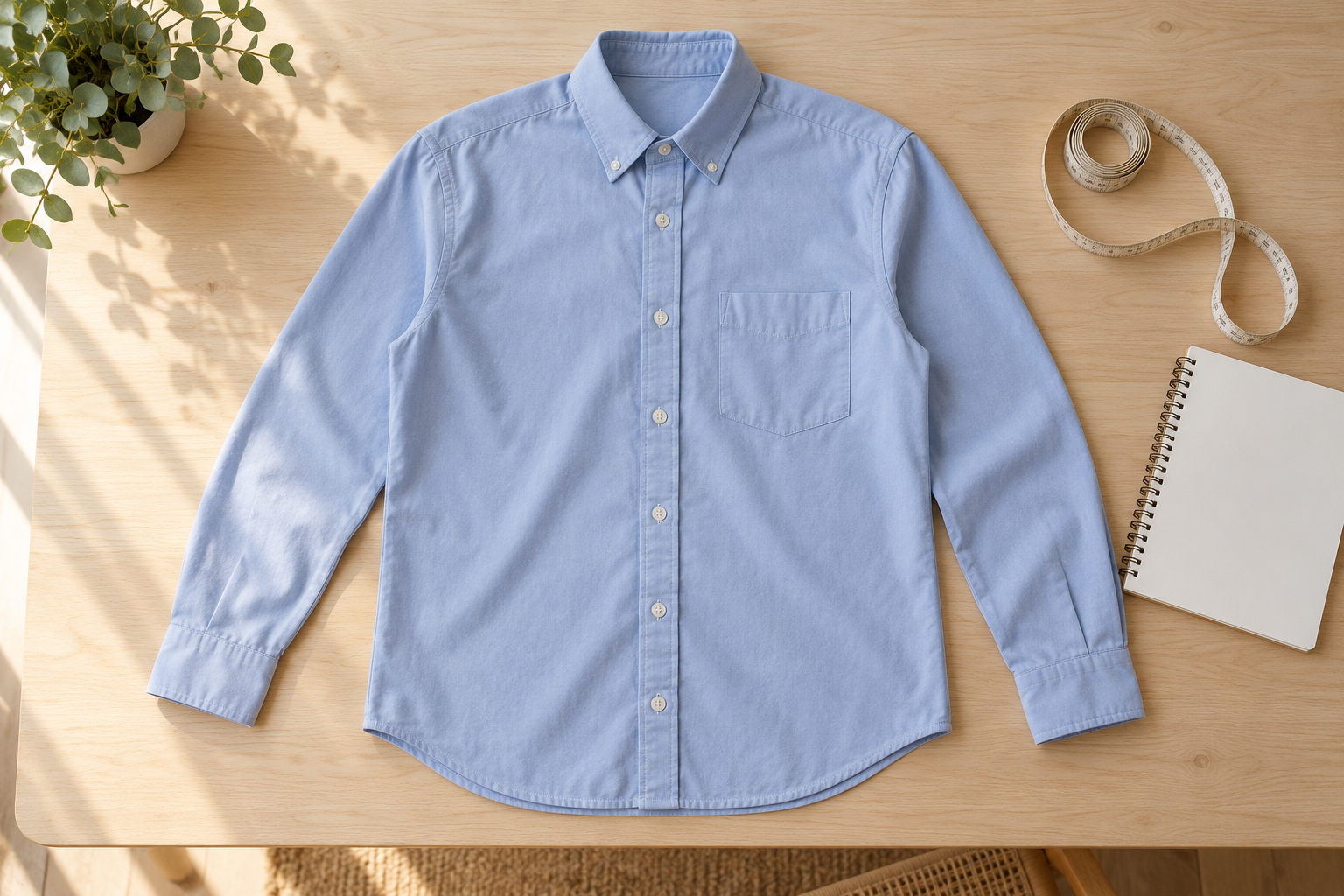
The buttoned blue shirt illustrates a useful starting state for a woven reference: closed and lying naturally, with its shoulders and hem visible. The tape beside it is a prop, not a readable measurement. Use your own shirt and the seller’s diagram to establish the actual endpoints and numbers.
Compare the same points, not merely similar words
Chest width may be taken at a specified distance below the armhole. Sleeve length might begin at a shoulder seam, the neck or another point. Total length could refer to the front, back or a named shoulder point. Two entries called length can therefore describe different routes through the garment.
Place your reference on a surface large enough to support it without hanging off the edge. Fasten it as instructed and smooth obvious folds without pulling it wider. If the fabric is curved, gathered or heavily shaped, check whether the brand provides a method for that construction rather than forcing it into a rectangle.
Keep units consistent within a comparison. One inch equals 2.54 centimeters; converting a value does not fix a mismatch between measurement types. Write the unit beside every entry, and retain enough precision to understand the difference without treating a rounded retail dimension as a tailoring specification.
If one listing gives a range and another gives a single number, find out what each represents. A body range, a relaxed elastic waist and a manufacturing tolerance are different concepts. If the page does not explain the range, ask about it before deciding that both endpoints describe the same kind of fit.
Use flat-width arithmetic only when it applies
For a simple symmetrical garment measured flat across the chest, doubling the stated half-width can provide an approximate chest circumference. Do this only when the retailer confirms that interpretation. A measurement described as full bust circumference should not be doubled again, and an unusual construction may need a different method.
A fictional example, not a size recommendation: Suppose a simple top is confirmed to measure 52 centimeters flat across the chest. Doubling gives an approximate finished circumference of 104 centimeters. If the corresponding body circumference is 96 centimeters, the difference is 8 centimeters. That arithmetic describes the example; it does not prove the top will fit.
Now suppose another chart lists 104 centimeters as a body measurement. It is describing a wearer measurement, not the same finished top. You cannot compare the two entries as equivalent merely because the printed number matches.
Body and garment measurements need to correspond at the relevant point before the subtraction means anything. Different front and back shaping, darts, gathers or stretch can complicate the picture. When that happens, a direct comparison with a similar garment may be more useful than an apparently precise calculation.
Do not calculate an exact size from an illustration, a ruler pictured beside clothing or a model’s pose. Camera perspective and styling are not a measurement method. Ask for the product’s dimensions instead, especially when the missing information determines whether you can sit, fasten the garment or use an intended layer.
Understand ease without turning it into a fixed allowance
Ease is the difference between a finished garment measurement and the corresponding body measurement. Positive ease means the garment is larger at that point; negative ease means it is smaller. Berroco’s explanation places that difference in the context of design and personal preference.
The definition is useful, but there is no single number that makes every blouse, sweater and jacket comfortable. Fabric behavior, shaping, intended layers and the way you move all matter. A chart can help narrow the choice without replacing those other observations or a proper try-on.

The roomy rust sweater shows why garment dimensions do not have to equal body dimensions. Its loose body and dropped shoulder belong to a particular silhouette. The photograph cannot tell you its exact ease, whether its sleeves suit your arms or whether you would prefer that amount of room.
Lion Brand’s sweater guidance also recommends a familiar sweater as a reference. Keep the comparison within a similar type of garment. A stretchy fitted knit and a nonstretch woven blouse can have matching dimensions yet behave very differently when worn.
If a body chart already suggests a size, do not automatically add your preferred ease to your body measurement and enter the larger result as though it were your body. Read how that chart is intended to be used. Garment dimensions and the stated fit description provide the separate information about room.
Let relaxed fabric remain relaxed while comparing
A stretchy garment can give different readings depending on how hard it is pulled. Unless the instructions request a stretched measurement, keep it resting naturally. Note any special condition such as an elastic waistband measured relaxed and extended; those two values answer different questions and should remain separately labeled.
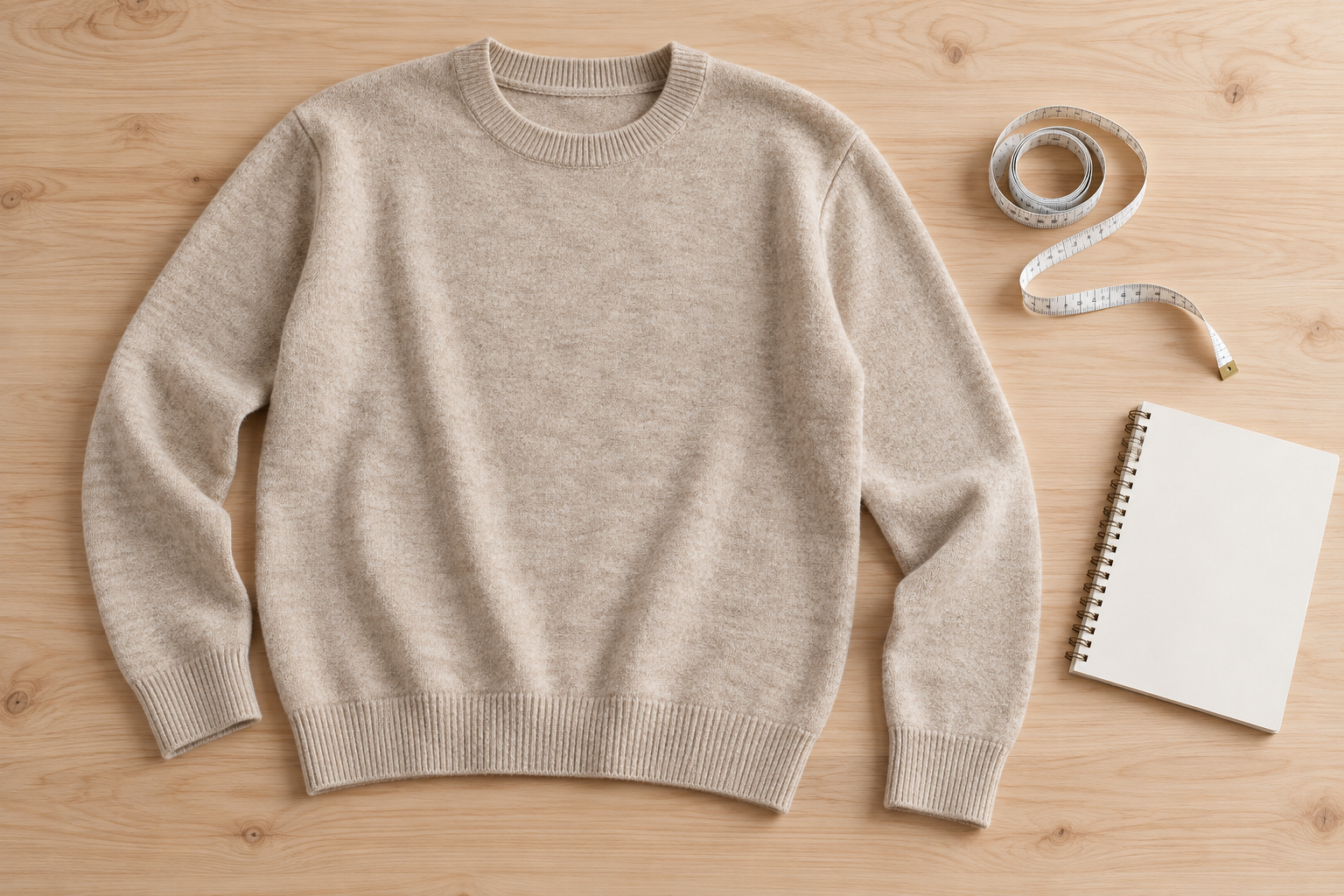
The oatmeal sweater is shown flat with its sleeves supported. Use that image as a reminder to record the whole garment, not just a chest width. The tape is not positioned to provide a numeric reading, and the knit’s appearance does not establish its fiber content, recovery or care requirements.
When comparing a favorite sweater with a new one, write down the neckline and shoulder construction as well as the numbers. A sleeve starting at a dropped shoulder can be shorter on paper than another sleeve while reaching the same place on an arm. Match the measurement route before deciding which is shorter.
Leave deliberate shaping in the garment rather than stretching it away for a cleaner-looking table entry. If a reference has become misshapen or no longer fits as you like, choose another piece or state the limitation in your notes. Its old size label cannot restore the original dimensions.
Check petite lengths separately from body circumference
A body chart that matches your bust, waist and hip may still leave unanswered questions about sleeves, torso length and where a waist seam sits. Those questions matter when shopping for a shorter frame. They need their own measurements or try-on observations rather than a smaller size chosen solely to reduce length.
Look for the actual sleeve, body and inseam information relevant to the garment. A petite label does not tell you precisely how a particular style has been adjusted. If the same piece comes in regular and petite versions, compare the dimensions available for each instead of assuming every measurement changes by one fixed amount.
For pants, a liked inseam remains a useful reference only with the rise, leg shape and intended shoes in mind. Our jeans inseam guide looks at that length decision in more detail. Keep it separate from choosing enough room at the waist and hip.
For a dress, mark where your reference waist seam sits when worn and compare the seller’s stated shoulder-to-waist measurement if available. A total length alone cannot reveal that placement. When the important measurement is missing, requesting it is more informative than guessing from the model’s height.
Handle between-size results with a specific question
If different body measurements point to different sizes, follow any item-specific brand guidance and identify where fit is most important for that construction. A closely shaped woven dress presents a different decision from an open cardigan. Do not assume the smaller or larger option is automatically right in every case.
Compare both candidate sizes with your reference measurements where they are supplied. Then ask what remains unresolved: room through a particular area, length, closure or a planned underlayer. A useful question names the style, size, measurement point and whether you need a relaxed or stretched dimension.
A retailer question you can adapt: “For this style in sizes X and Y, is the chest figure a flat width or a full circumference? Where is it measured, and is the fabric relaxed? Could you also confirm the sleeve measurement method and body length?” Replace the placeholders with the actual item details.
Read the current return conditions before ordering, including deadlines and restrictions relevant to the item. That is especially useful when the seller cannot provide a measurement you need. A clear chart improves the decision, but it does not justify assuming that every uncertainty will resolve after delivery.
Keep the information that helps the next purchase
At try-on, use the intended underlayers, fasten the garment normally, sit and move your arms. Compare the result with your notes. If the chest is fine but the sleeves are wrong, record that specific observation rather than concluding that the whole brand always runs large or small.
Save the style name, size, chart type, units and the measurements you found useful. Add a short preference note such as “room works over a light tee” or “length works with these flats.” That record is more useful next time than a size letter without context.
The strongest size-chart decision compares like with like, then checks the parts the chart cannot answer. Your body record, a suitable reference garment and a clearly labeled retailer chart each contribute different information. Together they help you choose deliberately without expecting one number to describe every aspect of fit.
Images are AI-generated editorial illustrations, including two selected from our existing image library. They explain comparison methods and visible shapes; they are not measured product samples, garment tests or evidence that a named size will fit a reader.

Alia Hashim
I'm Alia Hashim — a passionate blogger and founder of Modern Lady Magazine. I started this platform to create a space where women could find inspiration, empowerment, and real-life solutions for style, beauty, wellness, and beyond. Through Modern Lady Magazine, I aim to celebrate the modern woman — confident, creative, and full of dreams — while sharing ideas that help nurture both inner strength and outer beauty. Every story, every tip, every idea here is crafted to inspire you to embrace your journey and live life beautifully, one step at a time.
View author profile →


One Comment